
Carrier Ethernet: private L2 circuits in Riga
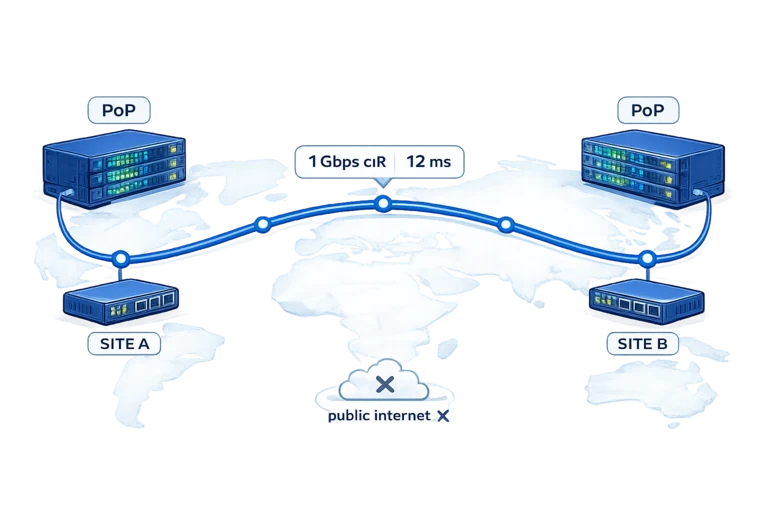
CloudHosting SIA, a Latvian IT infrastructure provider since 2016 with its own network AS58269, delivers point-to-point Carrier Ethernet Layer 2 circuits (MEF-style E-Line) between your sites, its PoPs and its Tier 3+ data centre in Riga, for companies whose VoIP, replication or trading traffic must stay off the public internet. You get an Ethernet port at each end, bandwidth from branch-office links to multi-gigabit, and availability and repair terms set in the contract.
Why a private circuit
Predictable by design
A dedicated circuit means stable latency and jitter, which VoIP, replication and trading traffic actually need.
Simple to consume
You get an Ethernet port at each end. VLANs, routing and equipment stay fully under your control.
Isolated from the internet
The circuit is not reachable from outside: no DDoS surface, no exposure, no tunnelling overhead.
Grows with you
Bandwidth upgrades are a config change on our side, not a new construction project.
What you can order
- Point-to-point E-Line circuits between our PoPs
- Connections from your office to our data centre
- VLAN transparent transport for your own segmentation
- Bandwidth options from modest links to multi-gigabit
- Availability and repair terms agreed in the contract
- Monitoring with alerting on circuit health
Pricing depends on endpoints and bandwidth: request a quote with your two sites.
How it works
- 1
Feasibility
You name the two sites; we confirm reach, media and available bandwidth.
- 2
Offer
You get the circuit design, monthly price and SLA terms.
- 3
Turn-up
We deliver the ports, test end to end and hand over a monitored circuit.
Our own Tier 3+ data centre in Riga
Your services run on hardware we own and operate in Latvia, under EU jurisdiction. A second live region in the Netherlands; Dubai (DXB1) on request.
- N+1 redundant power and cooling
- Own BGP network with redundant uplinks
- Monitoring 24/7, engineers on working days 9:00 to 17:00
- GDPR and EU data residency
Key facts about Carrier Ethernet circuits
Short answers to the questions companies ask first. Each point is confirmed again in the written offer.
| Provider | CloudHosting SIA, a Latvian IT infrastructure provider operating since 2016, with its own network AS58269 |
|---|---|
| What you get | A point-to-point Layer 2 circuit (MEF-style E-Line) with an Ethernet port at each end; VLAN transparent, no routing on our side, not reachable from the internet |
| Where | Between your sites, our PoPs and our Tier 3+ data centre in Riga, Latvia; reach and media are confirmed per address in a feasibility check |
| Bandwidth | From modest branch-office links up to multi-gigabit, depending on the media at both sites; upgrades within port capacity are a configuration change |
| Price | On request: a monthly price per circuit, set by the two endpoints and the bandwidth; prices without VAT |
| Minimum term | Set per circuit in the written offer and the contract |
| Availability and repair | Terms agreed in the contract (SLA per contract); every circuit is monitored with alerting on circuit health |
| Support | Monitoring and incident response 24/7. Engineers answer on working days 9:00-17:00 Riga time, in English, Latvian and Russian. |
| Contract | With CloudHosting SIA, an EU company registered in Latvia; invoices in EUR, nothing is charged automatically |
Checked:
Carrier Ethernet questions
How is a Carrier Ethernet circuit different from a VPN over the internet?
CloudHosting's Carrier Ethernet circuit is a private Layer 2 path that never touches the public internet, while a VPN rides the internet and shares the path with everyone else. A VPN therefore inherits whatever congestion, packet loss and jitter that path has on a given day, and encryption adds tunnelling overhead on your routers. On a circuit, latency stays where you measured it, and the contract sets availability and repair terms instead of best effort. A VPN is still fine for occasional remote access or offices where cost matters most; when VoIP, replication or trading traffic needs predictable behaviour every day, a private circuit is the right tool.
Can the circuit end in your data centre?
CloudHosting can end the circuit in its Tier 3+ data centre in Riga, and that is the most common design: a point-to-point link from your office straight to where your servers, backups and cloud resources run. In practice your office network and your hosted equipment behave like one local network, without tunnels and without exposing anything to the public internet. Day-to-day work such as replication and moving large backups also gets simpler, because that traffic stays on the private path. Name your office address in the quote request, and during the feasibility step we confirm reach and media all the way to your site.
What bandwidth can I get?
CloudHosting delivers Carrier Ethernet from modest branch-office links up to multi-gigabit trunks, and the achievable speed depends on the two endpoints. Reach, the media available at each site and the capacity on the route set the ceiling, which is why we run a feasibility check first. Tell us the two sites and the target speed, and we confirm what is actually deliverable before you commit to anything. If you are not sure what speed you need, describe the workload, for example backup windows or replication volume, and we will size the link together with you, so it fits the real need rather than a guess.
Do you monitor the circuit?
CloudHosting monitors every Carrier Ethernet circuit with alerting on circuit health, so a fault shows up on our side without you having to notice it first and call. The SLA terms agreed in your contract define both availability and repair times, so a fault is worked against agreed deadlines rather than whenever convenient. Monitoring covers the circuit itself, the path between your two ports; everything behind the ports, your VLANs, routing and equipment, remains your responsibility. If you see anything odd, write to support and we tell you the current state of the circuit and what is being done about it.
What is a point-to-point E-Line circuit?
CloudHosting's E-Line circuit is the point-to-point service type of the MEF Carrier Ethernet framework: a private Layer 2 Ethernet connection between exactly two sites. You get an Ethernet port at each end, and everything you send into one port comes out of the other, which is why it is often described as one long cable. Because the service works at Layer 2, there is no routing on our side: your VLANs, your IP addressing, your routing protocols and your equipment stay entirely under your control. The limitation is in the name: it connects two sites, so a design with three or more locations needs more than one circuit.
How much does a Carrier Ethernet circuit cost?
CloudHosting quotes each Carrier Ethernet circuit individually as a monthly price, because the two endpoints and the bandwidth drive most of the cost: how far apart the sites are, what media is available at each and how much capacity you want on the route. That is why the process starts with a quote rather than a shop page. Send us your two sites and the target speed, and you receive the circuit design, the monthly price without VAT and the SLA terms in one offer. Requesting a quote does not commit you to anything, so it is also a practical way to compare the offer with your current connectivity.
Can I run my own VLANs over the circuit?
CloudHosting's circuits are VLAN transparent: the tags you send into the port at one site come out unchanged at the other, so your existing segmentation keeps working end to end. You do not renumber anything, you do not register your VLAN plan with us, and you do not coordinate changes: add or remove VLANs on your own schedule and the circuit simply carries them. This matters because office and server networks usually already have a VLAN structure, and a circuit that forced you to rebuild it would cost a lot of time. Your switches and routers at both ends remain yours to configure.
Can I upgrade the bandwidth later?
CloudHosting upgrades bandwidth within the capacity of the delivered ports and the route as a configuration change on our side, not a new construction project: no new cabling, no site visit, no second installation. In practice you write to support, we confirm the new speed and the adjusted monthly price, and the change is applied to the existing circuit. That is why it makes sense to start with the bandwidth you need today instead of overbuying for the future. If a requested speed ever goes beyond what the current media can carry, we tell you during the feasibility check and offer a design that can.
Carrier Ethernet or dark fiber: which one do we need?
CloudHosting offers both between sites in Riga: a Carrier Ethernet circuit gives you a ready Ethernet port at each end with the bandwidth you order, while dark fiber gives you a bare strand that your own optics light. Choose Carrier Ethernet if you want a working Layer 2 link without running optical equipment, with monitoring and repair terms from us. Choose dark fiber if your team has network engineers who want to set their own speeds and encryption and are ready to watch the optics themselves. Both are quoted from the two endpoints, so one request can compare them for your route.