
Bare metal NVIDIA GPU servers on request: HGX B300, B200 and H200
CloudHosting provides bare metal NVIDIA GPU servers in European data centres for your project, from a single L40S card to multi-node HGX B300 clusters and GB300 NVL72 racks. Nothing is kept in stock: the GPU model, location, delivery date, contract term and price per GPU-hour are agreed per project and written into the contract before you sign.
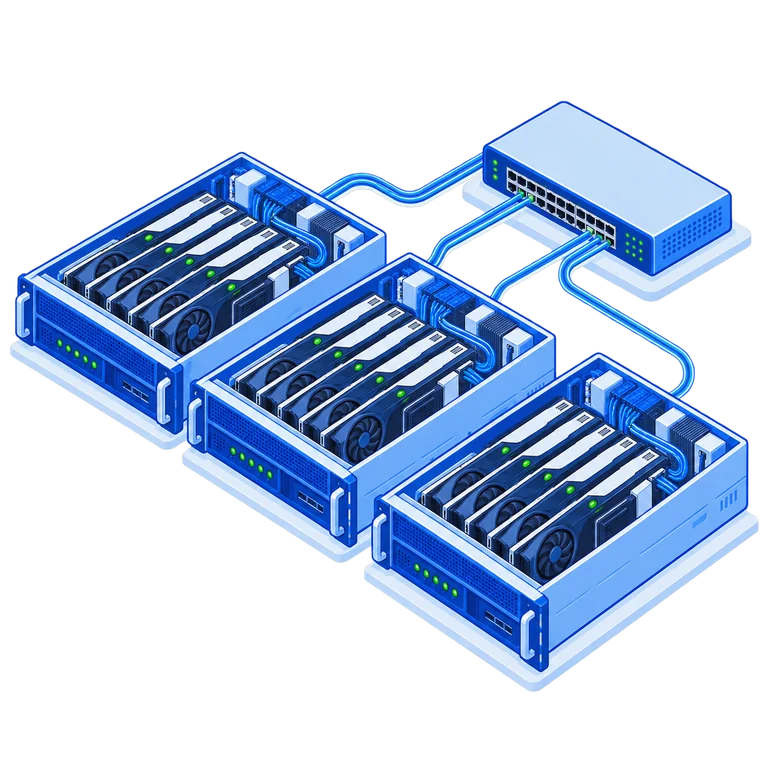
Key facts about our bare metal GPU servers
Short answers to the questions buyers ask first. Each point is confirmed again in the written offer.
| Provider | CloudHosting SIA, a Latvian hosting company operating since 2016, with its own Tier 3+ data centre in Riga |
|---|---|
| GPUs | NVIDIA HGX B300, HGX B200, GB300 NVL72, HGX H200, H100 SXM and NVL, RTX PRO 6000 Blackwell Server Edition, L40S |
| Availability | On request, not in stock. We source the hardware for your project, and you get a written delivery date before you sign. |
| Minimum order | One card for PCIe GPUs, one 8-GPU node for SXM platforms, one rack for GB300 NVL72 |
| Term | From 12 months; longer and multi-year terms agreed per project |
| Billing | Per GPU-hour or per node per month, in EUR, on a schedule agreed per project |
| Location | Europe. The data centre is chosen for each project by its power and cooling needs, and the country and the facility are written into the contract before signing. |
| Support | Monitoring and incident response 24/7. Engineers answer on working days 9:00-17:00 Riga time, in English, Latvian and Russian. |
| Contract | With CloudHosting SIA under EU law, invoiced in EUR, with a data processing agreement on request |
NVIDIA GPU platforms we provide on request
Specifications as NVIDIA publishes them. Every platform is sourced per project, so every row is on request; the exact server model, CPU, RAM and local storage are confirmed in the offer.
| Platform | Form factor | Memory per GPU | GPU interconnect | Network per GPU | Power | Typical use | Availability |
|---|---|---|---|---|---|---|---|
| NVIDIA HGX B300 Blackwell Ultra |
8 SXM GPUs per node | up to 288 GB HBM3e | NVLink 5, 1.8 TB/s per GPU | up to 800 Gb/s (ConnectX-8) | DGX B300: about 14 kW per system | Training and inference of the largest models, long-context and FP4 workloads | On request |
| NVIDIA HGX B200 Blackwell |
8 SXM GPUs per node | 180 GB HBM3e | NVLink 5, 1.8 TB/s per GPU | up to 400 Gb/s (ConnectX-7) | DGX B200: about 14.3 kW per system | Training, fine-tuning and high-throughput inference | On request |
| NVIDIA GB300 NVL72 Blackwell Ultra |
72 GPUs and 36 Grace CPUs per rack, liquid-cooled | up to 288 GB HBM3e; 20 TB per rack | NVLink 5, one 72-GPU domain, 130 TB/s in total | up to 800 Gb/s (ConnectX-8) | about 120 kW per rack | Very large models that need one 72-GPU NVLink domain | On request |
| NVIDIA HGX H200 Hopper |
8 SXM GPUs per node | 141 GB HBM3e | NVLink 4, 900 GB/s per GPU | up to 400 Gb/s (ConnectX-7) | up to 700 W per GPU; DGX H200: 10.2 kW max per system | Inference and fine-tuning on the mature Hopper software stack | On request |
| NVIDIA H100 SXM Hopper |
8 SXM GPUs per node | 80 GB HBM3 | NVLink 4, 900 GB/s per GPU | up to 400 Gb/s (ConnectX-7) | up to 700 W per GPU; DGX H100: 10.2 kW max per system | Training and inference on a platform with wide software support | On request |
| NVIDIA H100 NVL Hopper |
PCIe card, one or more per server | 94 GB HBM3 | NVLink bridge to one adjacent card, 600 GB/s | Per server design | up to 400 W per card | Inference and fine-tuning in standard PCIe servers | On request |
| NVIDIA RTX PRO 6000 Blackwell Server Edition Blackwell |
PCIe Gen5 card, one or more per server | 96 GB GDDR7 with ECC | None | Per server design | up to 600 W per card | Inference, fine-tuning of smaller models, rendering and video | On request |
| NVIDIA L40S Ada Lovelace |
PCIe Gen4 card, one or more per server | 48 GB GDDR6 with ECC | None | Per server design | 350 W per card | Inference, graphics, rendering and video | On request |
Vendor figures per NVIDIA. NVLink bandwidth is the total per GPU in both directions. Network speeds are the NIC per GPU in NVIDIA DGX reference systems, and system power is given for NVIDIA DGX systems; servers from other vendors built on HGX boards differ by model and cooling. The final configuration is confirmed in the quote. Need a single card for your own server? See our AI servers page
Specifications checked against NVIDIA sources:
B300 vs B200 vs H200: which one to choose
Choose HGX B300 when memory decides: each GPU carries up to 288 GB of HBM3e, against 180 GB on B200 and 141 GB on H200, so larger models and longer contexts fit on one 8-GPU node.
According to NVIDIA, B300 and B200 share fifth-generation NVLink at 1.8 TB/s per GPU and the same sparse FP4 peak of 144 PFLOPS per 8-GPU system; B300 leads on dense FP4 (108 against 72 PFLOPS) and on networking, with 800 Gb/s per GPU instead of 400 Gb/s.
H200 stays a sound choice for inference and fine-tuning of models that fit in 141 GB per GPU, and B200 or H200 suit FP64-heavy HPC code better than B300, because NVIDIA cut double precision sharply on Blackwell Ultra.
| Specification | NVIDIA HGX B300 | NVIDIA HGX B200 | NVIDIA HGX H200 |
|---|---|---|---|
| Memory per GPU | up to 288 GB HBM3e | 180 GB HBM3e | 141 GB HBM3e |
| GPU memory per 8-GPU system | about 2.1 TB | 1440 GB | 1128 GB |
| Memory bandwidth per GPU | up to 8 TB/s | up to 8 TB/s | 4.8 TB/s |
| NVLink per GPU | 1.8 TB/s (NVLink 5) | 1.8 TB/s (NVLink 5) | 900 GB/s (NVLink 4) |
| Dense FP4 per 8-GPU system | 108 PFLOPS | 72 PFLOPS | No FP4 support |
| NIC per GPU | 800 Gb/s (ConnectX-8) | 400 Gb/s (ConnectX-7) | 400 Gb/s (ConnectX-7) |
| FP64 (double precision) | Sharply reduced, not for FP64 HPC | Suited to FP64 HPC | Suited to FP64 HPC |
| Power | up to 1100 W per GPU; DGX B300: about 14 kW per system | 1000 W per GPU; DGX B200: about 14.3 kW per system | up to 700 W per GPU; DGX H200: 10.2 kW max per system |
Figures per NVIDIA. FP4 is dense; NVIDIA quotes 144 PFLOPS sparse FP4 for both HGX B300 and HGX B200. The B300 system memory is the figure on NVIDIA's HGX and DGX B300 pages. NICs and system power are those of NVIDIA's DGX B300, DGX B200 and DGX H200; per-GPU power in HGX B300 and B200 servers comes from server vendor documentation.
What we agree for each project
Nothing sits on a shelf, so every point that decides cost and risk is settled up front and written into the offer and the contract.
Location
A data centre in Europe chosen for the power and cooling your project needs, from a single node to liquid-cooled racks. The country and the facility go into the contract.
Delivery date
A written date based on confirmed supply and a confirmed facility. Depending on the platform and the volume, it is weeks to months away.
Contract term
At least 12 months, up to a multi-year contract. The term shapes the price, so tell us early how long you need the capacity.
Billing
Per GPU-hour or per node per month, in EUR, with the invoicing and payment schedule agreed per project.
Network fabric
NVLink inside each node. Between nodes, InfiniBand or Ethernet designed per project for your node count and traffic, plus internet uplinks.
Storage
Local NVMe in each node as configured in the offer, and shared storage for datasets and checkpoints designed per project if you need it.
Managed scope
Root access always. On request we deliver the OS with the NVIDIA driver and CUDA installed, add monitoring and handle hardware replacement; Kubernetes, Slurm and the rest are scoped per project.
Hardware replacement
How failed GPUs, drives and other parts are replaced is agreed for your platform and location and set out in the offer.
How GPU server rental works
Four steps from your first message to servers you can log in to.
- 1
Send your requirements
GPU model and count, contract term, preferred location and start date, network and storage needs, and whether you want the servers managed.
- 2
Get options in writing
We return one or more options, each with a platform, a location, a written delivery date, the term and a price per GPU-hour or per node per month.
- 3
Sign the contract
You sign with CloudHosting SIA under EU law. The country, the facility and the power budget are confirmed in writing before signing.
- 4
Hand-over and operation
We install the servers and hand them over with root access. Monitoring and incident response run 24/7; engineers answer on working days 9:00-17:00 Riga time.
Why bare metal for GPU work
A bare metal GPU server is a dedicated GPU server in the strict sense: a whole physical machine that only you use, with nothing between your code and the GPUs, unlike a GPU cloud instance.
No virtualisation layer
Your operating system runs directly on the hardware, with no hypervisor between your workload and the GPUs.
All GPUs, full NVLink
You get every GPU in the node and the complete NVLink topology between them, exactly as the platform was designed.
Root access
Install the operating system, driver and CUDA version your stack needs, and change them when you need to.
Predictable multi-GPU performance
No other tenant shares the node, so training and inference speed does not depend on what a neighbour is running.
Your own stack
Run Kubernetes, Slurm, plain containers or your own scheduler. Nothing is imposed by a platform you do not control.
Hardware only you use
Your data and models stay on machines dedicated to you, in a country and facility named in your contract.
What teams run on bare metal GPU servers
Typical workloads for an AI GPU server with every GPU dedicated to you.
Training and fine-tuning
Pre-training and fine-tuning on 8-GPU nodes or multi-node clusters, with NVLink inside each node and a fabric between nodes designed for your job size.
Inference at scale
Serve models with vLLM, TensorRT-LLM or SGLang on hardware sized to your model, context length and traffic.
Private LLM for your company
Want a ready private AI server rather than raw capacity? Our AI servers page covers turnkey machines for a private LLM and single GPU cards.
See AI serversResearch, rendering and video
Research workloads, 3D rendering and video processing, typically on RTX PRO 6000 Blackwell or L40S servers.
Power and cooling, stated up front
Current GPU servers draw far more power than ordinary servers, and that decides where they can run. We settle it before the contract, not after.
DGX B300 and DGX B200: about 14 kW per node
NVIDIA gives about 14 kW for a DGX B300 system and about 14.3 kW for a DGX B200, both air-cooled 10U machines. A few such nodes need a rack with power and cooling well beyond an ordinary server rack.
GB300 NVL72: about 120 kW per rack
A GB300 NVL72 rack holds 72 GPUs and 36 Grace CPUs, draws about 120 kW according to NVIDIA and needs liquid cooling, so it goes to a liquid-cooled high-density data centre in the EU chosen for the project.
For every project we confirm the facility, the power budget and the cooling in writing before the contract is signed. If a location cannot take the load, we say so and propose one that can.
Bring your own servers, or buy instead of rent
Two alternatives to renting: host the GPU servers you already own with us, or buy the hardware outright.
Bring your own GPU servers
Already own HGX or PCIe GPU servers? Ask about server colocation: send the server model, the number of units and the rated power, and before anything ships we check the power and cooling available and agree the placement per project. You can combine them with rented capacity under one contract.
Buy instead of rent
If you would rather own the hardware, we sell NVIDIA cards from L4 to H200 NVL for your own servers, and complete servers built to your specification.
Why CloudHosting
Facts you can check before you sign.
EU company since 2016
CloudHosting SIA is a Latvian company. Your contract and invoices are in EUR under EU law, and we serve clients worldwide.
Own Tier 3+ data centre
We run our own data centre at Berzaunes iela 1 in Riga, with N+1 power and cooling.
Own network, AS58269
We announce our own IP space over our own BGP network, AS58269, with redundant uplinks.
Data centres in Europe
Your servers run in a European data centre chosen for the project, with the country and the facility named in the contract.
Engineers who answer
Monitoring and incident response 24/7. Engineers answer on working days 9:00-17:00 Riga time, in English, Latvian and Russian.
One supplier, rent or buy
Rent anything from a single GPU server to multi-node clusters, buy GPU cards and servers outright, or place hardware you already own with us after a power check.
Tell us what you need
Send the GPU model, the number of GPUs or nodes, the term and your preferred location. We reply with options, each with a written delivery date. Engineers answer on working days 9:00-17:00 Riga time.
AI and automation guides
How-tos on running AI agents, private models and self-hosted AI from our team.
Bare metal GPU server questions
Where can I rent NVIDIA B300 bare metal servers in Europe?
CloudHosting SIA, a Latvian hosting company, provides bare metal NVIDIA HGX B300 servers and other dedicated GPU servers on request for clients in Europe and worldwide. We do not keep B300 capacity in stock: we source it for your project and agree the location, delivery date, contract term and price per GPU-hour before you sign. The servers run in a data centre in Europe chosen for the power and cooling your project needs, from a single 8-GPU node to large clusters and liquid-cooled rack-scale systems. The country and the facility are written into the contract before signing, and you get root access to dedicated hardware that no other client uses.
How much does it cost to rent an NVIDIA B300 per GPU-hour?
CloudHosting quotes B300 rental per project, per GPU-hour or per node per month, in EUR, and does not publish a price list; B200 rental, H200 rental, H100 rental and multi-node GPU cluster rental are quoted the same way. The price depends on the contract term, the number of nodes, the delivery date you need, the location and its power costs, the network fabric between nodes, the storage, the payment schedule and how much of the operation we manage. Longer terms and larger volumes usually lower the rate per GPU-hour. For a written quote, send the GPU model and count, the term, your preferred location and start date, the network and storage you need, and whether you want the servers managed or unmanaged. We reply with options, each with a location, a delivery date and a price.
What is the difference between NVIDIA B300 and B200?
B300 (Blackwell Ultra) has more memory and a faster network than B200, while both use the same NVLink generation. Each B300 GPU carries up to 288 GB of HBM3e against 180 GB on B200, and in NVIDIA's DGX systems every B300 GPU gets an 800 Gb/s ConnectX-8 NIC against 400 Gb/s ConnectX-7 on B200. Both give each GPU 1.8 TB/s of fifth-generation NVLink. Per 8-GPU system, NVIDIA lists 108 PFLOPS of dense FP4 for HGX B300 and 72 PFLOPS for HGX B200, while the sparse FP4 peak is 144 PFLOPS on both. B300 cuts FP64 sharply, so B200 is the better fit for double-precision HPC. A DGX B300 draws about 14 kW, a DGX B200 about 14.3 kW.
Is NVIDIA B300 better than H200?
For large models, yes: B300 has about twice the memory per GPU and a newer architecture, but H200 still fits many workloads well. A B300 GPU carries up to 288 GB of HBM3e with up to 8 TB/s of bandwidth, against 141 GB at 4.8 TB/s on H200. B300 also has fifth-generation NVLink at 1.8 TB/s per GPU, twice the 900 GB/s of H200. H200 draws up to 700 W per GPU and a DGX H200 system 10.2 kW at most, so it needs less power and cooling per node. If your model and batch fit in 141 GB per GPU, H200 on the proven Hopper software stack can be the more practical choice. We quote both.
What is the difference between HGX B300 and DGX B300?
HGX B300 is the NVIDIA platform with eight Blackwell Ultra SXM GPUs on one baseboard that server vendors build their own servers around, while DGX B300 is NVIDIA's own complete 10U system built on the same eight GPUs. Both give each GPU up to 288 GB of HBM3e and 1.8 TB/s of fifth-generation NVLink, so one 8-GPU node has about 2.1 TB of GPU memory according to NVIDIA. The difference is the rest of the server: in HGX B300 servers the vendor chooses the chassis, CPUs, memory, storage and cooling, with air-cooled and liquid-cooled versions, while DGX B300 is air-cooled, uses two Intel Xeon 6776P CPUs and draws about 14 kW according to NVIDIA. In a CloudHosting quote, the exact server vendor and model are named in the offer before you sign.
What is the difference between HGX B300 and GB300 NVL72?
HGX B300 is an 8-GPU server node, while GB300 NVL72 is a complete liquid-cooled rack that joins 72 Blackwell Ultra GPUs and 36 NVIDIA Grace CPUs in one NVLink domain. Both use the same Blackwell Ultra GPU with up to 288 GB of HBM3e and 1.8 TB/s of NVLink per GPU. In an HGX B300 node, NVLink connects 8 GPUs and larger jobs cross the network between nodes; in a GB300 NVL72 rack, all 72 GPUs share one 130 TB/s NVLink domain with 20 TB of GPU memory, according to NVIDIA. The trade-off is power and cooling: a DGX B300 node draws about 14 kW, while a GB300 NVL72 rack draws about 120 kW and needs liquid cooling. The minimum order is one 8-GPU node for HGX B300 and one full rack for GB300 NVL72.
How much memory does the NVIDIA B300 have?
Each NVIDIA B300 (Blackwell Ultra) GPU carries up to 288 GB of HBM3e memory, with up to 8 TB/s of memory bandwidth per GPU. An 8-GPU HGX B300 or DGX B300 system therefore has more than 2 TB of GPU memory; NVIDIA's HGX and DGX B300 pages give the total as about 2.1 TB. For comparison, B200 has 180 GB per GPU and 1440 GB per 8-GPU system, and H200 has 141 GB per GPU and 1128 GB per system. In a GB300 NVL72 rack, NVIDIA lists 20 TB of GPU memory across 72 GPUs, all in one NVLink domain. The memory per GPU is what decides how large a model, and how long a context, fits on one node.
How much power does a B300 server need?
An 8-GPU NVIDIA DGX B300 system draws about 14 kW, according to NVIDIA, and it is air-cooled in a 10U chassis. Servers from other vendors built on the HGX B300 board vary by model: NVIDIA gives up to 1400 W per Blackwell Ultra chip, and vendor HGX B300 systems run each GPU at up to 1100 W, in air-cooled or liquid-cooled versions. A rack-scale GB300 NVL72 needs about 120 kW per rack and liquid cooling. That is far above what an ordinary server rack is built for, so power and cooling decide where a B300 deployment can run. We confirm the facility and the power budget in writing before you sign.
What is the minimum order and contract term for GPU servers?
At CloudHosting, the minimum order is one card for PCIe GPUs such as L40S, RTX PRO 6000 Blackwell Server Edition or H100 NVL, one 8-GPU node for SXM platforms such as HGX B300, HGX B200, HGX H200 or H100 SXM, and one full rack for GB300 NVL72. The minimum contract term, in effect the minimum GPU lease, is 12 months; longer and multi-year terms are agreed per project and written into the contract together with the billing unit and the payment schedule. We bill per GPU-hour or per node per month, in EUR. The term affects both the price and the delivery options, so tell us early how long you need the capacity.
How long does delivery of GPU servers take?
Delivery of GPU servers from CloudHosting takes weeks to months, and you get a written delivery date before you sign. Nothing is kept in stock, so the date depends on the platform, on NVIDIA and server vendor supply at the time of your request, on the number of nodes, and on whether the chosen facility already has the power and cooling in place. Platforms in high demand, such as new HGX B300 clusters or GB300 NVL72 racks, usually take longer than PCIe configurations. We do not promise capacity we cannot date: the delivery date in your offer is one we can back with confirmed supply and a confirmed facility, and it is written into the contract.
Is bare metal better than a cloud GPU instance?
For long training runs and steady inference, bare metal usually is: you get the whole physical server with no virtualisation layer, all its GPUs, the full NVLink topology between them and root access. Multi-GPU jobs behave predictably because no other tenant shares the node, and you install your own operating system, driver, CUDA version, container runtime and scheduler. The trade-off is that capacity is fixed for the contract term: you cannot scale down to zero for a quiet week, and you run your software stack yourself unless we agree a managed scope. Cloud GPU instances suit short experiments and bursty loads; bare metal suits sustained work where you want the full node.
Do I need InfiniBand, or is Ethernet enough for a GPU cluster?
Inside one 8-GPU node you need neither: the GPUs talk over NVLink, and the network only matters once a job spans several nodes. For multi-node training, the fabric between nodes carries the collective traffic, such as NCCL all-reduce, so it has to be fast and non-blocking. NVIDIA supports both InfiniBand and Ethernet with RoCE on these platforms, and its B300 reference systems give each GPU a ConnectX-8 NIC of up to 800 Gb/s that runs either. InfiniBand is the established choice for large training clusters; Ethernet fits well where it matches your existing network and tools. We design the fabric per project, for your node count, topology and storage traffic, and put it into the offer.
Can I colocate my own HGX or GPU servers with you?
Yes, you can place your own GPU servers with CloudHosting through server colocation, subject to a power check. Standard colocation in our Tier 3+ data centre in Riga suits servers within a normal power budget. An 8-GPU system such as a DGX B300 can draw about 14 kW on its own, so for dense GPU servers we first check the power and cooling available and agree the placement per project. Tell us the server model, the number of units and the rated power, and we confirm in writing where and how the hardware can be installed. You can also combine your own servers with GPU capacity rented from us under one contract.
Where is my data, and who is my contract with?
Your contract is with CloudHosting SIA, a Latvian company operating since 2016, under EU law, with invoices in EUR. The country and the facility where your servers run are written into the contract before you sign, so you know exactly where your data is. Your servers run in a data centre in Europe chosen for the power and cooling your GPUs need, and we take your preferences on the country into account. For GDPR, we sign a data processing agreement on request. On bare metal you hold root access and control what runs on the servers and where the data goes.
What support do I get with bare metal GPU servers?
CloudHosting runs monitoring and incident response 24/7, and its engineers answer on working days from 9:00 to 17:00 Riga time, in English, Latvian and Russian. You always keep root access to your servers. On request we deliver them with the operating system, NVIDIA driver and CUDA installed, add monitoring and handle hardware replacement, and orchestration such as Kubernetes or Slurm is scoped per project. How failed GPUs, drives, power supplies and other parts are replaced depends on your platform and location, so it is set out in the offer and agreed before you sign. Tell us early which parts of the operation you want us to take on, because the managed scope affects the price.
Can I order NVIDIA Vera Rubin systems?
Yes, we take requests for NVIDIA Vera Rubin systems, and delivery depends on NVIDIA allocation. Vera Rubin is the NVIDIA platform that follows Blackwell Ultra; NVIDIA began production shipments in 2026 and supply is still limited, so dates for most buyers are uncertain. Tell us the configuration you are interested in, the number of nodes or racks and your time frame, and we will tell you what we can confirm and when. We do not promise a delivery date until we can put it in writing. If you need capacity sooner, we can quote HGX B300, HGX B200 or GB300 NVL72 for the interim and plan the move to Vera Rubin once it can be delivered.