
Office IT infrastructure for businesses in Riga
A server humming under someone's desk is a risk nobody budgeted for. We move the systems your company actually depends on into our data centre in Riga, set up access for the people who need it, and stay on to run it.
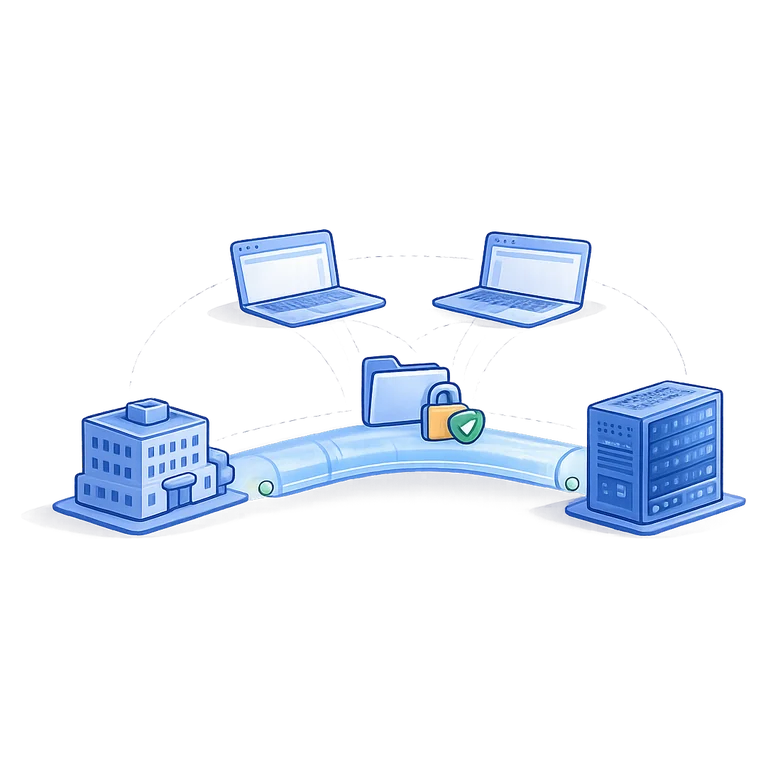
What changes for the company
The office stops being the weak point
Power cuts, a stolen tower or a flooded room no longer take the company offline. The systems live in a data centre built for it.
People work from anywhere
Remote desktops and VPN give the same working environment at the office, at home or on the road, without copying files around.
Backups you can actually restore
Copies run on a schedule and we test restores, because a backup nobody has ever restored is only a hope.
One number to call
Servers, licences, network and support come from us. No arguments between vendors about whose problem it is.
What a typical office setup includes
- Windows Server for domain, files and applications
- Remote desktops (RDS) with the licences that go with them
- File storage with permissions that match your structure
- VPN for staff and for branch offices
- Microsoft 365 for mail and collaboration
- Backup, monitoring and day to day administration
How we get there
- 1
We look at what you have
Which servers exist, what runs on them, how many people use what, where the data sits and what would hurt most if it stopped.
- 2
We put the design and the numbers in writing
Hardware, licences, migration steps and the monthly cost. You see the whole picture before anything is bought or moved.
- 3
We move it and keep running it
Migration is planned around your working hours. After the switch we watch the systems, apply updates and answer the phone.
Questions we get asked
Do we have to move everything at once?
No, and usually you should not. Most companies start with the piece that hurts most, often the file server or an ageing machine running an application everyone depends on. We move that first, let it settle, then plan the next step. Some systems stay in the office on purpose because moving them brings no benefit, for example a device tied to production hardware on site. The point of the first conversation is to work out that order together, not to sell you a single big migration.
What happens to our Windows and RDS licences?
We count what you actually need and tell you which licences you already own that can be reused. Windows Server, CALs and RDS CALs are ordered through us, so they arrive with the servers instead of being a separate purchase you chase later. If your licensing today is a mix of old purchases and nobody is quite sure what is covered, we go through it and write down where you stand. Licensing rules change, so we base the count on how your people actually work rather than on a template.
How do staff reach the systems after the move?
Two common ways, and often both. A VPN connects the office network to the servers so applications behave as though nothing moved. Published remote desktops give each person a full working environment they can reach from a laptop at home or a machine in a branch office. Which one fits depends on the applications: some are happy over VPN, others are far more comfortable running next to their database and being shown to the user as a desktop.
What does a setup like this cost?
There is no price list for it, and any provider who gives you one before looking at your systems is guessing. The bill has three parts: the servers, the licences your people actually need, and the monthly support. After the survey you get all three as concrete numbers, with the monthly figure fixed before anything is ordered, and you decide from there. What moves the number most is not the hardware, it is how many people need a remote desktop and how much data has to be kept and backed up.
We already use Microsoft 365. Does that change?
It does not have to. Mail, Teams and the files people keep in OneDrive can stay exactly where they are, and we take over the licences and the administration if you want one supplier for it. What usually moves into the data centre is the other half: the file server, the accounting or ERP system, and the applications that never fit into a cloud subscription. The two live together well, and in most offices that split is the whole design.
What happens if we decide to leave?
The data is yours and it leaves with you. We hand over a copy in a usable form, virtual machine images or plain files and a database dump, whichever fits what you are moving to, plus the documentation of how the setup is wired. There is no proprietary format holding it and no exit fee. We would rather you stayed because the service is good than because moving is painful.
Ready to start?
Deploy in minutes or talk to an engineer about what fits your project.